


Reviewed by our world-class neurosurgical team.
Understanding Your Options
The choice between disc replacement and spinal fusion represents more than a simple medical decision—it's a choice that will affect how your spine moves and functions for the rest of your life. Both procedures address degenerative disc disease effectively, both can eliminate or dramatically reduce pain, and both have helped millions of patients return to active lives. But they achieve these goals through fundamentally different approaches, and understanding those differences is essential to making the right choice for your specific situation.
The good news is that today's patients have options where previous generations had only one path. Thirty years ago, fusion was the only surgical option for degenerative disc disease. Twenty years ago, disc replacement emerged as an alternative but was viewed with skepticism by many surgeons. Today, both procedures have well-established track records, and the question isn't which one is "better" in some abstract sense, but which one is better for you given your age, anatomy, lifestyle, and goals. OrthoInfo provides detailed comparisons of both surgical approaches.
Spinal Fusion: Proven and Versatile
Spinal fusion has stood the test of time for good reason. The concept is straightforward: if a damaged disc between two vertebrae causes pain, eliminate that source of pain by making those two vertebrae into a single, immobile unit. The disc is removed, bone graft material is placed in the space where the disc used to be, and hardware—screws, rods, or plates—holds everything stable while nature does its work. Over three to six months, new bone grows through the graft material, eventually creating a solid bridge of bone that permanently connects the vertebrae.
The procedure's simplicity is part of its strength. Fusion works regardless of whether your facet joints are arthritic, regardless of your bone density (within reason), regardless of whether you have one, two, three, or more levels that need treatment. It's adaptable to virtually any spinal condition—instability, deformity, fracture, tumor, infection. This versatility means that fusion remains the appropriate choice for many patients who wouldn't be candidates for disc replacement.
Decades of research have validated fusion's effectiveness. Hundreds of studies involving tens of thousands of patients demonstrate that fusion reliably eliminates pain arising from diseased discs. The success rates are well-established—typically eighty to ninety percent of appropriately selected patients experience significant pain relief and improved function. Insurance companies cover fusion without hesitation because its effectiveness and safety are proven beyond any doubt.
But fusion's success comes with trade-offs that have become increasingly apparent as surgeons have followed patients for decades after surgery. Eliminating motion at one spinal segment doesn't eliminate your need to move. When you bend forward, twist to look over your shoulder, or reach overhead, that motion has to come from somewhere. The segments above and below a fusion compensate by moving more than they were designed to, and this increased stress accelerates their degeneration.
The phenomenon is called adjacent segment disease, and it's not rare. Studies tracking fusion patients for ten years or more show that twenty to thirty percent develop new disc degeneration and pain at levels next to their fusion. Some of these patients require additional surgery, and occasionally that surgery leads to another adjacent level problem years later, creating a cascade of operations that gradually reduce spinal flexibility.
The permanent loss of motion from fusion varies in its impact depending on how many levels are fused and where. A single-level fusion in the lower back might be barely noticeable—you may lose ten to fifteen percent of your total lumbar flexion, which most people don't miss in daily activities. But a two-level lumbar fusion can reduce flexibility more noticeably, and a three-level fusion creates genuine limitations. In the neck, single-level fusion is usually well-tolerated, but multi-level cervical fusion can make it difficult to look up, check blind spots while driving, or perform work that requires repeated neck movement.
Recovery from fusion requires patience because you're waiting for bone to grow, a biological process that can't be rushed. The first six to twelve weeks involve significant activity restrictions while the bone graft begins to consolidate. Return to full activities typically takes three to six months, and complete bone healing can take up to a year. This timeline is longer than disc replacement, which is worth considering if getting back to work or activities quickly matters to you.
Disc Replacement: Motion Preservation with Precision
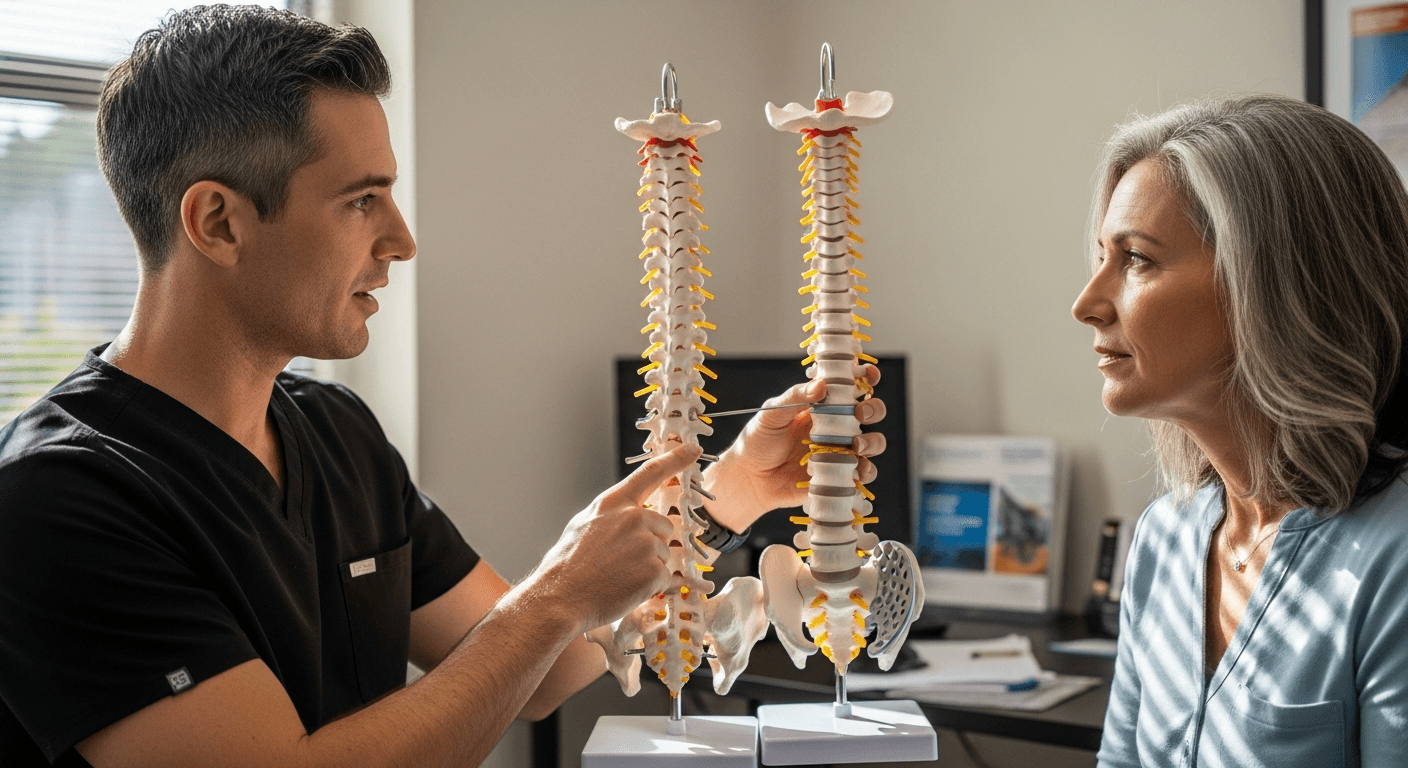
Artificial disc replacement takes a fundamentally different approach to the same problem. Instead of eliminating the painful disc and the motion it allows, disc replacement removes the disc and replaces it with an engineered device designed to maintain motion while eliminating pain. The concept seems almost too good to be true—pain relief without motion loss—but two decades of outcome data have proven that for appropriately selected patients, it works exactly as intended.
The procedure involves approaching the spine from the front—through a small neck incision for cervical replacement, or through the abdomen for lumbar replacement. The damaged disc is removed, the surfaces of the vertebral bodies above and below are carefully prepared, and the artificial disc is positioned with precision measured in millimeters. Unlike fusion, which requires months for bone to grow, disc replacement provides immediate stability. The device maintains normal disc height and allows motion in the directions your spine naturally moves—flexion, extension, rotation, and lateral bending.
The preservation of motion offers several advantages beyond simply allowing you to move normally. By maintaining motion at the treated level, disc replacement appears to reduce stress on adjacent segments, potentially preventing the adjacent segment disease that plagues many fusion patients. Studies comparing disc replacement to fusion have consistently shown lower rates of adjacent level degeneration in disc replacement patients over five, ten, and fifteen-year follow-up periods.
Recovery from disc replacement is typically faster than fusion. You're not waiting for bone to grow—you're waiting for soft tissues to heal, which happens more quickly. Many cervical disc replacement patients go home the same day. Lumbar replacement typically requires one to two nights in the hospital. Return to light activities often happens within two to four weeks, and many patients return to unrestricted activities by three months. This accelerated timeline makes disc replacement particularly appealing for patients whose livelihoods depend on physical capability or who simply want to minimize time away from activities they enjoy.
Long-term outcomes from disc replacement have proven durability. Modern implants tracked for ten, fifteen, even twenty years show maintained motion without significant wear or breakdown. Patient satisfaction rates consistently exceed ninety percent. The maintenance of motion means patients can return to demanding physical activities, sports, and occupational tasks that would be difficult after fusion.
But disc replacement isn't appropriate for everyone, and this is where careful patient selection becomes critical. The procedure requires good bone quality—osteoporosis or significant osteopenia can compromise implant fixation. The facet joints at the back of the spine must be healthy—if they're arthritic, they'll continue causing pain even after disc replacement addresses the front of the spine. Significant spinal instability, multi-level disease beyond what current FDA approvals allow, previous surgery at the same level, or certain deformities may all make fusion the better choice. The American Association of Neurological Surgeons provides detailed patient selection criteria and outcome data.
Disc replacement is newer technology with a shorter track record than fusion—roughly twenty years compared to fifty-plus for fusion. While that's certainly long enough to establish safety and effectiveness, it's worth acknowledging that fusion has decades more of long-term data. The procedure is technically demanding and requires surgeons with specific training and significant experience to achieve optimal results. And current FDA approvals generally limit cervical disc replacement to one or two levels, though this may expand as more data accumulates.
Comparing the Two Approaches Side by Side
When considering these two surgical options, several factors deserve careful attention because they affect both the surgery itself and your life afterward.
Recovery timelines differ substantially. After fusion, you can expect to stay in the hospital one to three days, though minimally invasive fusions often allow discharge within twenty-four hours. The return to light activities typically takes six to eight weeks, with full recovery requiring three to six months. Complete bone healing—the point at which the fusion is truly solid—takes six to twelve months, though you'll be back to most activities long before that. After disc replacement, hospital stays are shorter—often same-day discharge for cervical procedures, one to two nights for lumbar ones. Return to light activities often happens within two to four weeks, and full recovery typically requires just two to three months. Research in PubMed documents these recovery timeline differences.
Long-term outcomes show subtle but important differences. Fusion satisfaction rates run eighty to ninety percent—the vast majority of patients are glad they had the surgery. Disc replacement satisfaction rates are slightly higher at eighty-five to ninety-five percent. Both procedures effectively eliminate or dramatically reduce pain from degenerative disc disease.
The key difference appears in adjacent segment disease rates. Twenty to thirty percent of fusion patients develop adjacent level problems requiring potential additional surgery within ten years. Disc replacement patients show substantially lower rates of adjacent segment degeneration, suggesting motion preservation achieves its goal of protecting neighboring discs.
Physical restrictions after surgery vary significantly between the procedures. Single-level fusion creates minimal long-term restrictions for most patients—you can return to virtually all activities including contact sports, though some surgeons recommend against them. Multi-level fusions create more noticeable limitations, particularly in flexibility. You'll adapt and can still live an active life, but there are real restrictions on certain movements. Disc replacement, by contrast, typically allows near-normal range of motion with fewer long-term restrictions, making it particularly attractive for patients who want to maintain demanding physical activities.
Determining Your Candidacy
The question "Am I a candidate?" deserves honest, detailed analysis because getting this decision right determines whether you're likely to have an excellent outcome or face complications and disappointment.
Disc replacement works best for younger patients—typically those between eighteen and sixty years old—because motion preservation offers more benefit when you have decades of life ahead. If you're active and want to return to sports, heavy labor, or physically demanding hobbies, motion preservation becomes even more valuable. You need relatively limited disease—one or two levels rather than multi-level degeneration—because widespread arthritis usually indicates fusion would be more reliable. Your facet joints must be healthy, your bone density adequate, and you can't have significant instability. You should have tried conservative treatment for at least six months without adequate relief.
Fusion becomes the better choice when you have characteristics that make disc replacement inappropriate or risky. Multi-level disease requiring extensive stabilization works better with fusion's proven ability to address complex problems. Severe facet arthritis means motion will continue causing pain even if disc replacement addresses the disc itself. Spinal instability or deformity requires the rigid fixation fusion provides. Osteoporosis or poor bone quality can compromise disc implant fixation. Previous fusion at adjacent levels may make disc replacement technically difficult or biomechanically problematic. Infections, tumors, or certain complex spinal conditions typically require fusion. Advanced age isn't an absolute contraindication to disc replacement, but the risk-benefit calculation shifts toward fusion's proven track record when you're over sixty-five.
Questions That Shape the Decision
Engaging actively in this decision requires asking the right questions and understanding the answers. Your surgeon should be able to tell you exactly what your imaging shows—not just "degenerative disc disease" but which specific levels are affected, how severe the degeneration is, whether facets are healthy or arthritic, whether there's instability, and how these findings correlate with your symptoms.
If you're a candidate for both procedures—and many patients are—you should understand the specific pros and cons for your case, not just general information. A thirty-five-year-old athlete has a very different calculus than a sixty-five-year-old with moderate activity goals. Your surgeon's experience with both procedures matters enormously. A surgeon who performs mostly fusions and occasional disc replacements may unconsciously bias recommendations toward the procedure they know best. Surgeons who perform both procedures regularly in significant volume can offer more balanced, unbiased counsel.
Success rates vary by condition. A simple single-level herniated disc has different outcomes than multi-level spondylolisthesis. Understanding what "success" means for your specific problem helps set realistic expectations. Recovery timelines should be specific to your situation—your job's physical demands, your overall health, your goals for returning to activities. Generic timelines are useful starting points, but personalized projections based on the surgeon's experience with patients like you provide better planning information.
No surgery succeeds every time, so understanding what happens if the procedure doesn't provide adequate relief is crucial. What are revision rates for your specific condition? If you need additional surgery, what would that involve? Will the same surgical team continue caring for you, or will you be referred elsewhere? These questions reveal a lot about a surgeon's commitment to long-term patient care.
Expertise You Can Trust
At Legacy Neurosurgical & Spine Centers, our board-certified neurosurgeons have deep expertise in both fusion and disc replacement procedures. This matters because we're not invested in promoting one procedure over the other—we're invested in helping you achieve the best possible outcome. Our comprehensive evaluations determine which procedure is most appropriate for your specific anatomy, condition, and goals.
We use advanced techniques including minimally invasive approaches for both fusion and disc replacement when appropriate, reducing tissue trauma and accelerating recovery. Our Joint Commission-accredited surgical centers feature state-of-the-art technology and experienced surgical teams who perform these procedures daily. From your initial consultation through complete recovery, we support you at every step.
With over five thousand spine procedures performed and two decades of experience, our surgeons are among the most experienced in Georgia for both fusion and disc replacement. We've helped thousands of patients return to active, pain-free lives, and we can provide the expertise and honest guidance you need to make the best decision for your future.
Taking the Next Step
If chronic neck pain or back pain from degenerative disc disease is limiting your life, if you're wondering whether surgery might help, if you've been recommended for fusion but want to know if disc replacement might be an option—or vice versa—schedule a consultation to get answers.
We offer free consultations at all nine of our locations across the Atlanta area: Atlanta, Marietta, Riverdale, Peachtree City, Carrollton, Cartersville, Columbus, Rome, and Tucker. You can reach our patient care coordinators at (770) 291-8987 or schedule online to book an appointment at the location most convenient for you.
Bring your imaging studies if you have them, along with records of treatments you've tried. Come with questions—we'll take the time to answer them thoroughly. Expect an honest assessment of whether fusion, disc replacement, or continued conservative management makes the most sense for your specific situation. Learn more about what to expect during treatment and recovery planning. Our goal is to help you make an informed decision you can feel confident about, whatever that decision turns out to be.
The choice between fusion and disc replacement is significant, but you don't have to make it alone. Our experienced team is here to provide the expert guidance, comprehensive evaluation, and honest counsel you deserve.
This article provides educational information about spine surgery options and is not intended as medical advice. Individual treatment recommendations should be made after comprehensive evaluation by a qualified spine surgeon.